


Finding their feet: the life cycle of wood frogs
Amphibians are one of the most vulnerable groups of animals worldwide, facing threats from climate change, habitat loss, disease, and pollution. Approximately 68% of Canadian amphibians are at risk according to the Committee on the Status of Endangered Wildlife in Canada (COSEWIC). My doctoral research investigates the effects of natural gas industry contaminants on wood frogs (Lithobates sylvaticus), a species widely distributed across North America.
This work gives me a front-row seat to the incredible amphibian life cycle. Watch the extraordinary journey of a fertilized wood frog egg as it develops into an embryo, a tadpole, and finally a juvenile froglet.

In late winter, adult wood frogs gather in ephemeral ponds to lay their eggs. Each female lays a mass of several hundred eggs encased in layers of protective jelly.

A fertilized egg begins to divide into two cells. You can see the tension surrounding the line where the cells will separate.
The cells continue to divide, but the embryo does not yet grow bigger. Instead, the cells get smaller.
The embryo develops a structure called the neural plate (left), which then becomes the neural folds (right), and will eventually become the brain and spinal cord of the tadpole.

The embryo is beginning to take the shape of a tadpole, with a visible head and tail end.

The embryos have developed into larvae (tadpoles) and hatched. You can see their coral-like gills on either side of their heads. At first, they use their yolk sac for nutrients (see the swollen area on the belly).

Look closely! You can see individual blood cells circulating through the gills with every heartbeat.
This little tadpole has depleted its yolk sac and begun to feed on plant matter. It has also covered its gills with protective tissue. As it grows, it develops a shimmery gold colouration.
The hind legs begin to develop before the front legs, starting as tiny “limb buds”. Over time, the legs grow longer and stronger, and individual toes develop.
The front legs develop internally and emerge nearly fully developed. The tadpole is ready to make its way onto the land! In the lab, we place the frog into a semi-aquatic tank to let it crawl out of the water on its own.
During the transition to land, the tadpole begins breathing air and reabsorbs its tail. The froglet on the right only has a tail nub left and is ready to move to a fully terrestrial enclosure.
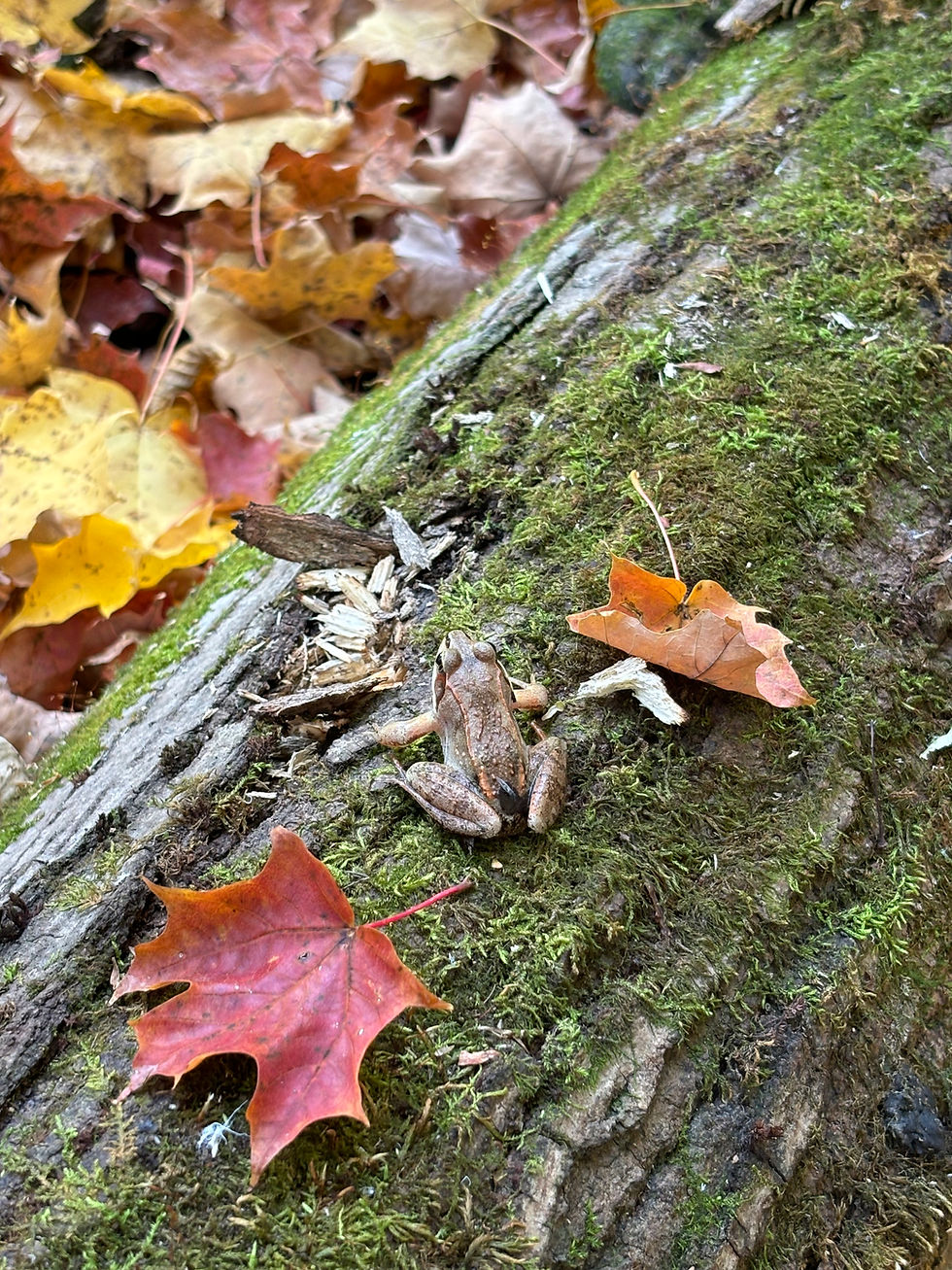
Throughout autumn, the juvenile frog feasts on insects and other prey, growing larger and preparing for winter. In the spring, the cycle repeats!


Comments